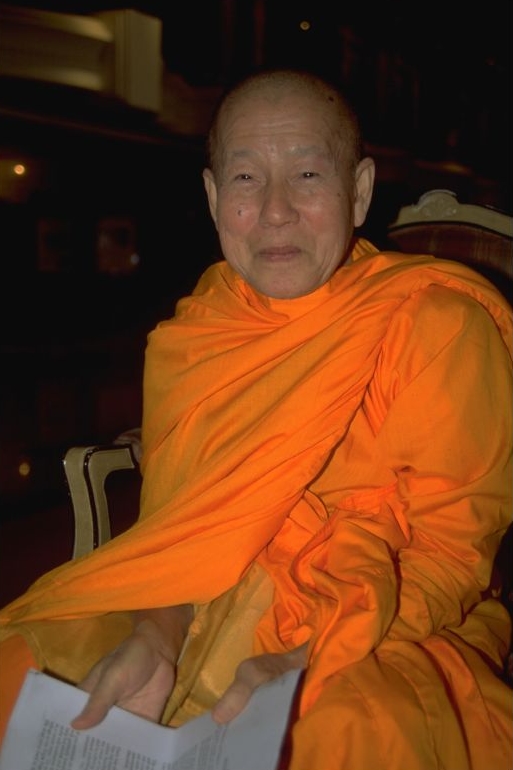
Wisdom for a Wounded World
Teachings & Philosophy
Four pillars of wisdom that guided a nation from genocide to grace — compassion, forgiveness, mindfulness, and the healing of wounds both personal and collective.
Four pillars of wisdom that guided a nation from genocide to grace — compassion, forgiveness, mindfulness, and the healing of wounds both personal and collective.
Maha Ghosananda's teachings were not abstract philosophy confined to monastery walls. They were living wisdom, forged in the crucible of genocide and applied to the urgent work of rebuilding a shattered society. His words carried the weight of personal loss and the luminosity of one who had transcended it.
For Maha Ghosananda, compassion was not sentiment — it was the fundamental nature of reality. He taught that when we truly see the suffering of others, our natural response is compassion, just as a mother instinctively reaches for a child in pain.
In the refugee camps, he demonstrated this by sitting with those who had lost everything — their families, their homes, their country — and simply being present. His compassion was not expressed through grand gestures but through the quiet power of presence.
He extended this compassion even to the perpetrators of the genocide, understanding that they too were caught in cycles of suffering. This radical compassion was perhaps his most challenging teaching, and his most transformative.
"The suffering of Cambodia has been deep. From this suffering comes great compassion."
Perhaps no teaching of Maha Ghosananda was more radical or more necessary than his teaching on forgiveness. In a country where families had been torn apart, where neighbors had been forced to kill neighbors, the call to forgive seemed almost impossible.
Yet he taught that forgiveness was not about condoning what had happened. It was about releasing the grip of hatred on the human heart. "Hatred never ceases by hatred," he would say, quoting the Buddha. "Hatred only ceases by love."
This was not naive optimism. Maha Ghosananda had lost nearly his entire family. He understood the depth of loss. But he also understood that carrying hatred was like holding a burning coal — it consumes the one who holds it.
"We must find the courage to leave our temples and enter the temples of human experience, the temples of suffering, the temples of justice."
The Dhammayietra peace walks were, at their heart, exercises in mindfulness. Each step taken in awareness, each breath drawn in consciousness, was a practice of peace. Maha Ghosananda taught that mindfulness was not retreat from the world but engagement with it at the deepest level.
He showed that mindful awareness could transform even the most terrifying situations. Walking through minefields, he maintained a calm presence that reassured those around him. His mindfulness was contagious — it created a field of peace that others could step into.
In his teachings, mindfulness was the foundation of all other virtues. Without awareness, compassion becomes sentimentality. Without presence, forgiveness becomes mere words. It is through mindful attention that we truly see — and seeing, we are transformed.
"When we are mindful, we are aware. When we are aware, we understand. When we understand, we love."
Maha Ghosananda understood that the wounds of genocide do not heal with political treaties or economic development alone. They require spiritual medicine — the deep work of processing trauma, restoring dignity, and rebuilding community.
He approached healing as a collective endeavor. The peace walks were not individual spiritual quests but communal acts of healing. By walking together, by chanting together, by facing the landscape of their trauma together, Cambodians began to process what had happened to them.
His approach anticipated what modern psychology calls collective trauma healing. He recognized that when an entire society has been traumatized, individual therapy alone is insufficient. What is needed is a shared narrative of survival and hope — and that is precisely what the Dhammayietra provided.
"A peaceful heart makes a peaceful person. A peaceful person makes a peaceful community. A peaceful community makes a peaceful nation. And a peaceful nation makes a peaceful world."
In the stillness between breaths, peace awaits. This was the essence of his teaching.
To truly appreciate these teachings, one must understand the historical context from which they emerged.
Historical Context