Cambodia's Story
Historical Context
From darkness into light — understanding the conflict, the destruction of Buddhism, and the spiritual rebirth that followed under Maha Ghosananda's guidance.
From darkness into light — understanding the conflict, the destruction of Buddhism, and the spiritual rebirth that followed under Maha Ghosananda's guidance.
Cambodia's modern history is scarred by one of the most devastating genocides of the 20th century. Between 1975 and 1979, the Khmer Rouge regime, led by Pol Pot, systematically murdered an estimated 1.5 to 2 million people — nearly a quarter of the country's population.
The regime sought to create an agrarian utopia by eliminating all traces of modern civilization. Intellectuals, professionals, artists, and religious leaders were targeted for execution. Cities were emptied. Families were separated. The country was transformed into a vast labor camp where starvation, disease, and violence were daily realities.
The Khmer Rouge reserved particular brutality for Buddhism, which had been the spiritual and cultural heart of Cambodian society for centuries. The regime viewed religion as a threat to their revolutionary ideology and set about its total destruction.
Of an estimated 60,000 Buddhist monks in Cambodia before the genocide, fewer than 3,000 survived. Temples — which had served as the centers of education, community, and spiritual life for generations — were systematically demolished, converted into prisons, or used as execution sites. Sacred texts were burned. The very fabric of Cambodian spiritual life was torn apart.
The destruction of Buddhism was not merely physical. It was an attempt to erase the spiritual identity of an entire people — their sense of meaning, their connection to their ancestors, their hope for the future. The trauma of this spiritual annihilation would take generations to heal.
In the aftermath of the genocide, as Cambodia slowly emerged from its nightmare, it was Buddhism that provided the framework for healing. The Dharma — the teachings of the Buddha on suffering, impermanence, and compassion — offered a vocabulary for processing unimaginable trauma.
Maha Ghosananda understood this intuitively. He knew that Cambodia could not be rebuilt through political institutions alone. The country needed spiritual rebuilding — a restoration of meaning, of community, of hope. And it was through the restoration of Buddhism that this would happen.
Monks were reordained. Temples were reconstructed. The rhythms of religious life — the chanting, the ceremonies, the community gatherings — began to return. Slowly, painfully, the spiritual heart of Cambodia began to beat again.
Buddhism provided the spiritual framework for processing collective trauma. The teachings on suffering (dukkha) gave Cambodians a way to understand and contextualize their experience within a larger cosmic perspective.
Temples became the first places where communities reformed. They served as schools, gathering spaces, and centers of mutual support — just as they had for centuries before the genocide.
In a society where people had been forced to betray their deepest values, Buddhism offered a moral compass. The five precepts and the teachings on right action provided a foundation for rebuilding ethical community life.
Buddhism was inseparable from Cambodian identity. Its restoration was not merely religious but cultural — a reclamation of everything the Khmer Rouge had tried to destroy.
The Buddhist teachings on forgiveness and compassion offered a path beyond cycles of revenge. This was essential in a society where perpetrators and victims often lived side by side.
Monasteries had traditionally been Cambodia's primary educational institutions. Their restoration helped rebuild the country's intellectual and cultural life from the ground up.
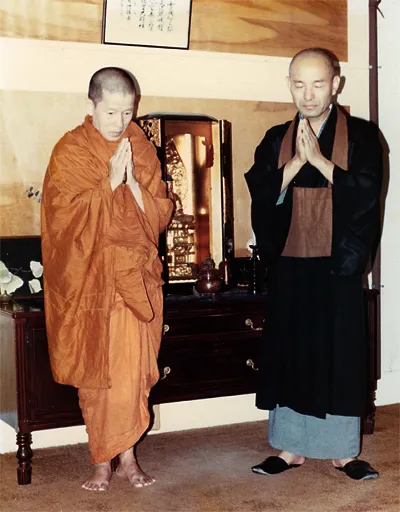
Appointed as the Supreme Patriarch (Sangharaja) of Cambodian Buddhism, Maha Ghosananda bore the immense responsibility of guiding the spiritual restoration of an entire nation. He approached this role not as a position of authority but as a sacred duty of service.
Under his gentle leadership, Buddhism in Cambodia slowly rose from near-extinction to become once again the beating heart of Cambodian society. His legacy as Sangharaja is not one of institutional power but of spiritual courage — the courage to lead with love in the aftermath of hatred.